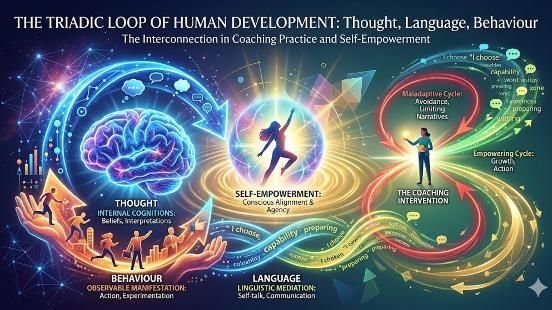
Enhancing training outcomes: a unified framework for coaching interventions and leadership accountability

In modern corporate and educational training settings, a coach’s ability to intervene effectively determines the speed, depth, and sustainability of skill acquisition. While traditional training often relies on top-down knowledge transfer, integrating coaching tools into training environments bridges the gap between passive learning and autonomous, identity-driven growth. By synthesising humanistic psychology, second language acquisition theory, neurological levels, and modern leadership models, coaches can equip trainees to actively assume personal accountability for their own development.
Safety, Readiness, and the Readiness for Change: Maslow, Krashen, and Hersey-Blanchard
Before any skill acquisition or ownership of growth can occur, a coach must address the trainee’s psychological state and baseline maturity. Abraham Maslow’s Hierarchy of Needs dictates that lower-level needs—specifically psychological safety and belonging—must be satisfied before individuals can pursue cognitive growth and self-actualisation.
In a training setting, this baseline aligns with Stephen Krashen’s Affective Filter Hypothesis. Krashen posits that high anxiety, low self-esteem, or defensiveness acts as an invisible barrier, preventing information from being processed. If a trainee feels judged, their affective filter spikes, blocking learning.
To transition this safety into accountability, the coach blends Krashen's theory with the Hersey-Blanchard Situational Leadership® Model. This model measures a trainee’s readiness through two lenses: competence and commitment (willingness/confidence). A coach adjusts their stance based on this developmental maturity, moving from highly directive coaching to autonomous delegation. True accountability cannot be demanded from an anxious, underskilled trainee ( stage); it must be carefully scaffolded.
Pragmatic Coach Question (Low Maturity / High Filter): “Looking at the roadmap for this new technical skill, what part of this process feels like a high-stakes pressure point for you, and how can we adjust our practice today to make it feel like a safe space to experiment?”
Relational Attunement and the Leader-Member Exchange (LMX)
To actively dismantle these cognitive barriers, coaches use behavioural attunement. Mirroring and matching are neuro-linguistic programming (NLP) techniques used to build rapid, subconscious rapport by reflecting a trainee’s physical posture, vocal tempo, and linguistic choices.
This somatic alignment operationalises the Carl Rogers Person-Centred Approach. Rogers’ core conditions - Unconditional Positive Regard, empathy, and congruence - require the coach to accept the trainee completely without judgement.
When applied to leadership, this alignment perfectly mirrors Leader-Member Exchange (LMX) Theory. LMX theory states that high-quality, high-trust relationships between leaders and subordinates yield significantly higher organisational commitment, lower turnover, and greater autonomy. When a coach uses Rogers' principles to move a trainee into the “in-group”, the trainee stops hiding mistakes out of fear and starts owning them out of mutual respect.
[Mirroring & Matching] => [Rogerian Positive Regard] => [High LMX (In-Group Trust)] => [Radical Accountability]
Pragmatic Coach Question (Building LMX & Trust): "I noticed your tone shifted when we discussed the client presentation phase. If we strip away the fear of getting it wrong, what is the core message you actually want to express?"
Designing Optimised Input and Shared Accountability: Krashen () and Choice Theory
Once rapport is established, the coach applies Krashen’s Input Hypothesis (i+1). Krashen argues that learners progress when they receive input that is exactly one step beyond their current level of competence (i).
If the training material is at i + 0, the trainee is bored; if it is at i + 2, they experience cognitive overload and frustration.
To bridge this with accountability, the coach introduces William Glasser’s Choice Theory. Choice Theory states that all human behaviour is an attempt to satisfy internal needs (e.g. survival, love, power, freedom, fun), and that we are solely responsible for our choices.
By matching the input exactly to i+1 , the coach removes the trainee's primary excuse for avoiding accountability ("It's too hard" or "It's a waste of time"). The trainee must choose whether or not to engage with a perfectly balanced challenge.

Visual framework generated via AI tools based on my research and theoretical syntheses
Deepening Impact: Robert Dilts’ Logical Levels and Transformational Leadership
To ensure that newly acquired skills and accountability stick, coaching interventions must transcend mere environmental or behavioural adjustments. Robert Dilts’ Logical Levels Pyramid provides a structural diagnostic tool to identify where a learning block resides. The levels move from surface to deep internal structures: Environment, Behaviour, Capabilities, Beliefs/Values, Identity, and Purpose.
Trainers often make the mistake of addressing a skill deficit strictly at the Behavioural level ("do this differently"). An effective coach elevates the intervention to the Beliefs or Identity level, turning the intervention into an act of Transformational Leadership. Transformational leaders do not just manage transactions; they inspire followers to change their underlying perceptions, values, and identity, thereby fostering intrinsic accountability.

If a trainee struggles to assume ownership of their project's failure, the bottleneck is rarely a lack of capability; it is usually a belief or identity conflict ("If I make a mistake, I am an incompetent professional").
Pragmatic Coach Questions across Dilts' Levels for Accountability:
Capability Level: "What internal resources or past training experiences can you draw on to execute this strategy effectively?"
Belief/Value Level: "What do you believe to be true about leaders who use this specific management style, and how is that belief helping or hindering your growth?"
Identity Level (The Ultimate Accountability Pivot): “As you step fully into this new operational role, what does it mean to be the primary author of your own career trajectory?”
Conclusion
Maximising training efficacy requires moving beyond rote instruction. By lowering the affective filter (Krashen) through high-trust, high-exchange relationships (Rogers/LMX), tuning in to the trainee’s pacing (Mirroring/Matching), pitching the challenge accurately, and aligning the skill with the learner’s internal identity (Dilts/Transformational Leadership), coaches successfully transition trainees from passive observers to self-directed, fully accountable leaders of their own development.
References
Dilts, R. (1990). Changing Belief Systems with NLP. Meta Publications.
Glasser, W. (1998). Choice Theory: A New Psychology of Personal Freedom. Harper Perennial.
Graen, G. B., & Uhl-Bien, M. (1995). Relationship-based approach to leadership: Development of leader-member exchange (LMX) theory of leadership over 25 years: Applying a multi-level multi-domain perspective. The Leadership Quarterly, 6(2), 219–247.
Hersey, P., & Blanchard, K. H. (1969). Management of Organizational Behavior: Utilizing Human Resources. Prentice Hall. Cited by: 20818
Krashen, S. (1982). Principles and Practice in Second Language Acquisition. Pergamon Press. Cited by: 19
Maslow, A. H. (1943). A theory of human motivation. Psychological Review, 50(4), 370–396.
Rogers, C. R. (1951). Client-Centred Therapy: Its Current Practice, Implications and Theory. Constable.
Rogers, C. R. (1957). The necessary and sufficient conditions of therapeutic personality change. Journal of Consulting Psychology, 21(2), 95–103.